
Asteroid 1291, Phryne, was discovered on September 15, 1933 by Eugene Delporte at the Royal Observatory of Belgium at Uccle, Brussels-Capital Region, Belgium. It has a period of 5 years, 87 days and is 26.78 kilometers (about 16 and 2/3 miles) in diameter.
It was named for Mnesarete, nicknamed Phryne (Greek for "toad," on account of her yellowish complexion), a famous Greek courtesan of the 4th century BCE who was a native of Thespiae in Boeotia (around Thebes), but lived mainly in Athens. She was renowned for her beauty, wealth and influence and served as a model for a number of sculptors.
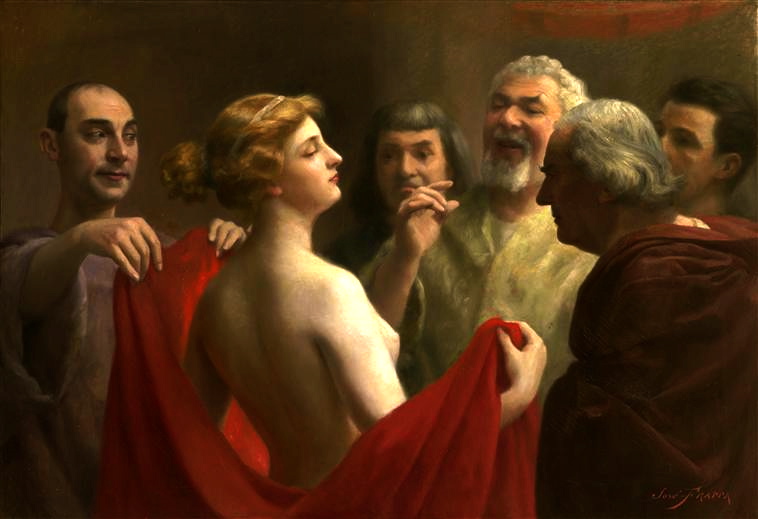
Phryne a painting by French artist Jose Frappa (1854-1904). It depicts a famous incident from Phryne's life in which she supposedly influenced the outcome of her trial (allegedly for impiety) by baring her breasts to the jury.
The meaning of asteroid Phryne seems to be: to prostitute oneself; "bad" women, female empowerment, free-spirited; possibly, to play the sex card.